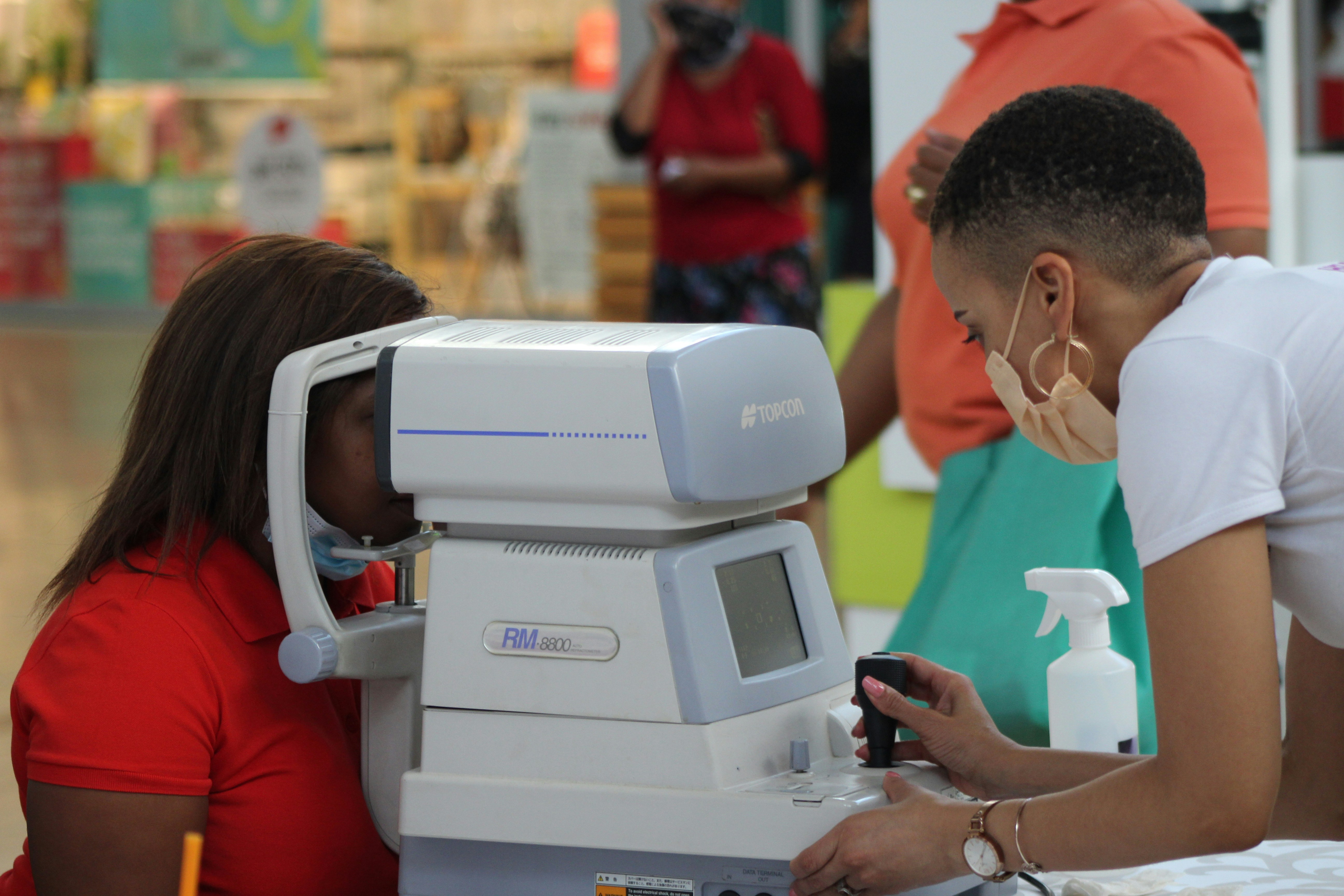
Refractive Errors
When the eye's shape prevents light from focusing correctly on the retina. The most common cause of correctable vision problems worldwide.
You squint to read road signs. Movie theater subtitles blur unless you're in the first ten rows. Night driving feels like everything beyond your headlights dissolves into haze. Your child holds their book six inches from their face and insists it's fine. None of this is dramatic. Myopia is gradual and sneaky — it rarely announces itself. Instead, it just quietly narrows the distance at which the world stays sharp.
Questions about this condition?
Schedule an evaluationEverything has a ghost. Letters look stretched or shadowed. You tilt your head slightly without realizing it. At night, streetlights and headlights fan out into starbursts or smears rather than clean points of light. Your child's teacher notices them tilting their head to see the board. You've had headaches after long reading sessions for years and assumed it was just how reading feels.
Questions about this condition?
Schedule an evaluationRetinal Conditions
The retina is the light-sensitive tissue lining the back of the eye — roughly the size of a postage stamp, it does the work of converting light into sight.
A small dark speck drifts across your field of vision — like a fly just out of reach. Or a thread, a cobweb, a translucent ring. It moves when your eye moves, then drifts lazily after you stop. Flashes are different: brief lightning-like streaks, usually at the edges of vision, often in a darkened room. They're not imaginary. They're real signals from inside your eye — and knowing which kind you're experiencing matters enormously.
Questions about this condition?
Schedule an evaluationIn early stages: nothing. That's what makes it dangerous. You may have significant retinal changes with perfectly normal vision. As it progresses: blurring that fluctuates with blood sugar levels. Dark spots or empty areas in your central vision. Colors that seem washed out. Difficulty reading fine print. If there's bleeding into the vitreous, sudden dark floaters or a red haze across vision.
Questions about this condition?
Schedule an evaluationDry Eye & Surface Disease
The tear film is a three-layer system that protects, lubricates, and nourishes the eye's surface. When it breaks down, the results range from mild discomfort to significant vision disruption.
A burning, stinging, or scratchy sensation — like something is in your eye, but nothing is there. Your eyes water constantly, which feels paradoxical. By 3 PM, the screen has become unbearable. Contact lenses that used to be comfortable now feel like sandpaper by noon. You blink more than you used to. Or you notice you've been staring without blinking for long stretches. Vision fluctuates — clear one moment, then blurry, then clear again after a few deliberate blinks.
Questions about this condition?
Schedule an evaluationPediatric Vision
Children's eyes are still developing until roughly age 8–10. Vision problems caught early are almost always correctable. Caught late, they can become permanent.
Children rarely complain about amblyopia — because from their perspective, they've always seen this way. They don't know that one eye should be contributing more. Signs to watch for: one eye that turns in or out, tilting or turning the head to use the better eye, closing one eye in bright light, poor depth perception (misjudging distances, difficulty catching a ball), or a failed school vision screening. By the time a child says "I can't see well from this eye," significant amblyopia may already be established.
Questions about this condition?
Schedule an evaluationEmergency Symptoms
Some eye symptoms require same-day evaluation. This section exists to help you recognize them — not to alarm, but to inform.
You cover one eye and realize the other eye can barely see — or can't see at all. Or a curtain seems to have drawn across part of your visual field. Or vision went gray, then black, then partially returned (a TIA — "eye stroke" — can cause transient vision loss that resolves within minutes). Do not wait to see if it gets better. Do not schedule an appointment for next week. Sudden vision loss is an emergency. Call us immediately or go to an emergency room. The window for saving vision is often measured in hours.
Questions about this condition?
Schedule an evaluationReal people found their answer here
Every condition entry is reviewed by our clinical team for accuracy, then tested by patients for clarity.
I'd been putting off the floaters for two years, convinced I was overreacting. The page on vitreous detachment explained exactly what I was seeing — not scary, just honest. I booked the next morning.

Margaret T.
Retired teacher, 67 — Posterior Vitreous Detachment
My son's teacher flagged that he was squinting at the board. I found the astigmatism section at 11 PM on a Tuesday and it answered every question I had before I even thought to ask it.

Priya K.
Parent of an 8-year-old — Pediatric Astigmatism
As a type 2 diabetic I'd been anxious about every visual change. The diabetic retinopathy entry was the first thing I've read that didn't make me spiral. It was specific and calm.

James W.
Software engineer, 54 — Diabetic Retinopathy monitoring
Every entry reviewed by our clinical team

Dr. Sarah Okonkwo, OD
Cornea & Contact Lens Specialist
FAAO · 14 years clinical practice

Dr. Marcus Reyes, OD, PhD
Retinal Disease & Low Vision
FAAO · Research Fellow, NEI · 11 years
You've done the research.
Now let's look together.
Bring this page to your appointment. Our doctors read every question you've researched here — and they'll meet you exactly where you are.